

When people first explore Spooky2, they often assume that success depends on finding the one correct frequency. In reality, many situations are far more complex. Environmental issues, pests, recurring or unclear conditions, and system-wide imbalances rarely respond to a single, perfectly defined frequency.
This is where Sweeps become valuable. Rather than targeting one frequency at a time, a Sweep works across a defined range, allowing coverage where certainty is not possible. This article explains what Sweeps are, the main types available in Spooky2, when they are most useful, and how Sweeps differ from Biofeedback.
What Is a Sweep in Spooky2?
A Sweep is a method of running frequencies across a continuous range instead of executing individual, fixed frequencies.
Sweeps are commonly used when:
- The exact target frequency is unknown
- The issue may involve variation, mutation, or stages
- Database options are numerous and difficult to prioritize
- The goal is broad coverage rather than pinpoint accuracy
Sweeps do not replace database programs. Instead, they provide a structured way to handle uncertainty when precise selection is difficult or unrealistic.
Common Sweep Types in Spooky2 (Purpose-Based Overview)
Spectrum Sweep
What it does:
A Spectrum Sweep runs frequencies from a defined low point to a high point, covering all values in between.
Why it’s useful:
- Ideal for Remote mode
- Effective for environmental issues and unknown targets
- Provides broad, systematic coverage
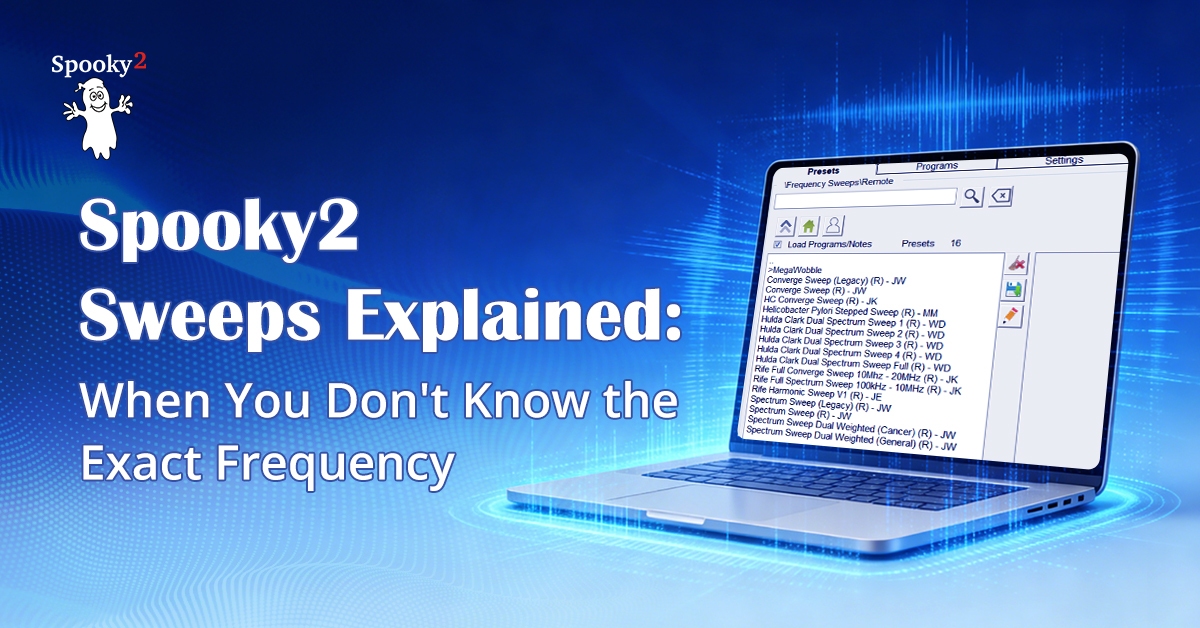
Path: Spooky2\Preset Collections\Frequency Sweeps\Remote\Spectrum Sweep (R) - JW
Practical guidance:
If you don’t know the exact frequency, Spectrum Sweep is usually the safest starting point.
Converge Sweep
What it does:
A Converge Sweep runs two frequency outputs simultaneously from opposite ends of a range, meeting in the middle.
Why it’s useful:
- Higher coverage density than a single-direction sweep
- Suitable when the target may span multiple frequency bands
- Often chosen to strengthen overall sweep effectiveness
Path: Spooky2\Preset Collections\Frequency Sweeps\Remote\Converge Sweep (R) - JW
Carrier Sweep
What it does:
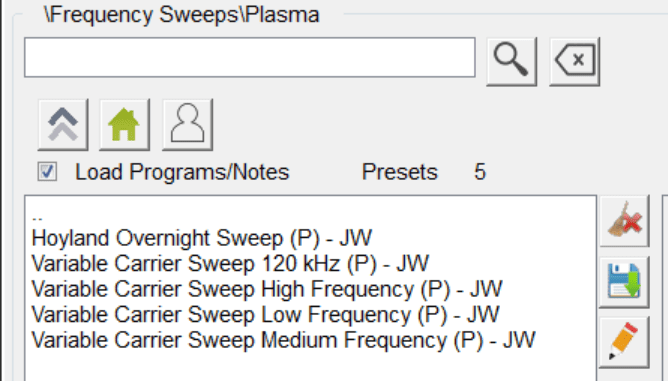
A Carrier Sweep applies a fixed carrier frequency combined with modulation, allowing frequencies to be delivered across a defined range through an amplified transmission method. This approach is based on carrier and sideband principles used in frequency modulation.
Why it’s useful:
- Uses a modified carrier-based sweep design
- Carrier remains harmonically linked to modulation
- Energy is focused around a defined centre frequency
- All frequencies in the range are addressed over time
- Different presets cover different carrier frequency ranges
Why Sweeps Work Well for Environmental and Pest Issues
Environmental challenges and pest-related problems share common characteristics:
- They involve populations, not single targets
- Targets may vary by stage or condition
- Sampling is imperfect and incomplete
Sweeps address these realities by covering a frequency range rather than relying on exact identification. This explains why Sweep-based approaches are frequently reported as effective in real-world environmental use cases.
For a documented example of this in action, see the case study on eliminating red ant colonies using Spooky2 frequencies
Sweeps Are Useful Beyond Environmental and Pest Problems
While environmental and pest issues are the most visible examples, Sweeps are useful in many other situations where uncertainty is high.
Sweeps are commonly appropriate when:
- The frequency range is broad or unclear
- Conditions change over time
- Multiple systems may be involved
- Database results are overwhelming or inconsistent
In these cases, Sweeps function as a coverage strategy rather than a precision tool. They allow users to proceed without first solving an unsolvable classification problem.
For readers interested in the instructor’s explanation of how and why Sweeps are structured this way in Spooky2, an official training session is available here:
Sweep vs. Biofeedback: Understanding the Difference
Sweeps and Biofeedback are often confused or compared, but they serve fundamentally different roles.
Sweep:
- Executes frequencies across a range
- Does not measure or rank responses
- Designed for coverage and execution
Biofeedback:
- Measures the body’s immediate response to frequencies
- Helps rank or filter frequency options
- Functions as a selection and screening tool
Biofeedback reflects current responses, not long-term relevance or complete system behavior.
Sweeps, by contrast, do not depend on immediate feedback and are better suited for situations involving variability, groups, or environmental targets.
They are not competing methods. They address different stages of decision-making.
How Sweeps and Biofeedback Can Work Together
In practice, many experienced users combine both approaches:
- Use Biofeedback to narrow options when clear feedback is available
- Use Sweeps when certainty is low or coverage is preferred
- Alternate between them as conditions evolve
There is no single “correct” order. The choice depends on the problem, the stage, and the user’s goal.
Conclusion: Sweeps as a Strategy, Not a Shortcut
Sweeps are not used because users lack knowledge. They are used because real-world systems are complex, dynamic, and often resistant to precise classification.
By prioritizing coverage over precision, Sweeps offer a practical and disciplined way to work with uncertainty.
When used appropriately—and with realistic expectations—they become one of the most versatile tools in the Spooky2 system.

muito interessante o tema mas o video nao tem legendas. Seria interessante disponibilizar para usuarios de varios paises possam ter acesso.
Obrigado pelo seu feedback e pela sua sugestão! Você está absolutamente certo(a), as legendas ajudam usuários de diferentes países a compreender melhor o conteúdo. Já registámos a sua sugestão.
What if I have a specific frequency I want to use, but then want it to “sweep”/also run plus and minus, say, 5 hertz?
1.) Is that actually a sweep and 2.) if so, how would I set that up (I’m having to make my own program, which is fine — I just need to know how to add these “sweeps” without adding every single individual frequency in).
Hi Jessica. It doesn’t sound like you’re doing a sweep with this setting. For detailed support and instructions please contact our support team at support@spooky2-mall.com