
Ovarian cysts are not uncommon among women, and many are discovered incidentally during routine checkups or ultrasound examinations. When this happens, the usual approach often involves watchful waiting, regular follow-up scans, or planning further intervention if needed.
During this process, some individuals begin to explore gentler, non-invasive ways to provide additional support while the body is being monitored. It is within this context that Spooky2 has been introduced as a frequency-based supportive option, gradually building a body of practical user experience worth referencing.
What Are Ovarian Cysts?
Ovarian cysts are typically fluid-filled, sac-like structures that form within or on the surface of the ovary. Their development can have a variety of contributing factors, including hormonal changes, the ovulation process, or natural shifts that occur during different phases of the body’s cycle.
Because these influences are part of ongoing biological rhythms, ovarian cysts can appear and change without always causing obvious symptoms. For many people, these changes are not necessarily permanent and may evolve over time. The pace and pattern of that change can differ from person to person, shaped by individual physiology and overall balance.

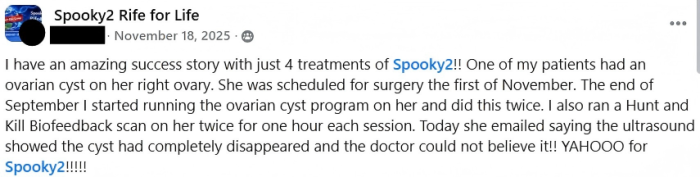
A Real User Story: Results After Four Sessions
Subject: An individual with a cyst on the right ovary
Case Context: Surgery scheduled for early November; Spooky2 use began in late September
Device Used: Spooky2 GeneratorX Pro
Observed Outcome: A follow-up ultrasound reported no visible cyst, a result that came as a surprise.
Usage Protocol Overview: Hardware, Software, and Programs Used
System Preparation
1. Software Preparation
Download and install the latest Spooky2 software from the official website.
2. Hardware Preparation
- GeneratorX Pro Essential Kit
Learn more on the product details page.
Frequency and Approach
A total of four sessions were completed, using the following approach:
1. Targeted Program Sessions (2 sessions): These sessions focused on running ovarian cyst–related database programs, using a consistent preset setup to provide targeted frequency-based support.
- Mode and Preset Selections: Select Contact Mode and use the Killing Preset.
Preset Path: \Shell (Empty) Presets\Contact\Killing (C) – JW
- Programs Used:
- Ovarian Cyst (BIO)
- Ovarian Cyst (CAFL)
- Ovarian Cyst (VEGA)
- Ovarian Cysts (ETDF)
2. Biofeedback Hunt & Kill Sessions (2 sessions): These sessions used biofeedback-driven scans in Contact Mode to identify responsive frequencies at the time of each run, adding an adaptive layer to the overall approach.
- Scan Type: Contact Mode and Hunt & Kill Biofeedback.
Preset Path: \Biofeedback\GeneratorX\GX Hunt & Kill (C) – JW
- Duration: Approximately 1 hour per session
Peptide Presets: An Optional Addition
In addition to the programs in the main database, the latest peptide preset can also provide excellent support for ovarian cysts. The high precision of these peptide presets enables them to target the root cause of the condition at the frequency level, going beyond basic symptom relief.
Please ensure you have downloaded the latest software/download the latest standalone peptide presets to your existing software.
👉 Click Here to Download.
Preset Path: \JW Peptides\Contact\Ovarian Cysts (C)
- Ovarian Cysts (C)
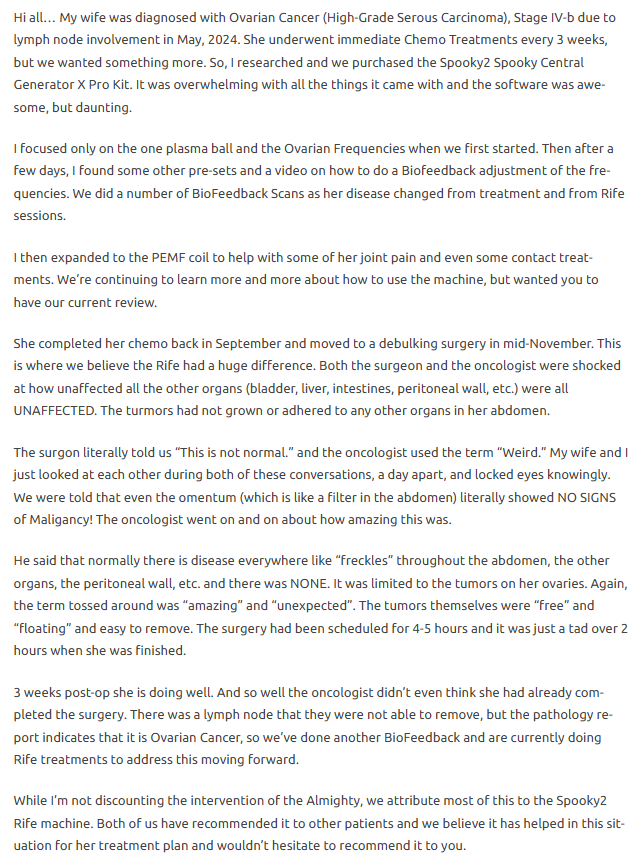
Additional User Feedback: Ovarian-Related Experiences with Spooky2
The user described using Spooky2 alongside ongoing care during an ovarian-related health situation. They explored multiple system modes over time, including Plasma, Contact, Biofeedback scans, and PEMF. During surgery, medical professionals reportedly noted that surrounding organs and tissues appeared unaffected, which the user described as unexpected. The user expressed strong personal confidence in Spooky2 as a supportive tool.
Final Thoughts
This case study and the additional user feedback shared above illustrate how Spooky2 has been explored by some individuals as a frequency-based support tool during ovarian-related health situations. Rather than presenting a one-size-fits-all approach, these experiences highlight the importance of individualized use, careful observation, and informed decision-making.
As with any supportive method, Spooky2 is not positioned as a replacement for medical care, diagnosis, or professional guidance. Instead, it represents one of many options that some users choose to explore alongside standard care, based on their own circumstances and comfort level. Each individual’s experience may differ, and results can vary accordingly.