

Since the release of the breakthrough JW RRM and the subsequent RRMD database (read more here) , we have received many insightful comments and specific practical questions from our community. This FAQ guide is compiled to help you navigate this powerful database with confidence.
What is RRM?
RRM stands for Resonance Recognition Model, which identifies the electromagnetic signature of biomolecules. Each chain has an energy pattern. Think of it like a string of pearls, and each pearl is an amino acid. RRM finds the frequency characteristics of that string. We identify the peak frequencies and then apply them.
What is the difference between RRM and RRMD programs?
Both RRM and RRMD programs integrate the RRM model (Resonance Recognition Model). RRM programs are comprehensive pathogen-disabling frequencies derived using proprietary JW_RRM methods. While RRM programs focus on human pathogens, RRMD programs pinpoint the peak frequencies of drugs and substances.
What makes RRMD different from the MW programs? Can we use multiple RRMD programs just like the MWs?
Unlike the MW programs that simply derive frequencies from the molecular weight of the mass, the RRM model differentiates the structure and the active part of the substance. And yes, you can use multiple RRMD programs and loop them. It’s suggested to put RRMD programs with single or double frequencies in separate presets.
When I use these RRM programs, are they fortifying the pathogens or destroying them?
RRM programs are designed to carry out precise interventions. They block the key survival axes (pathways) of the target pathogen, making it unable to survive.
Which one is more potent, RRM or peptide programs? Can they be used together?
Yes. They can work hand in hand because they work in totally different ways. Peptide programs promote healing by sending frequencies of the peptides involved in the natural healing process, whereas RRM programs block the key survival pathways of pathogens.
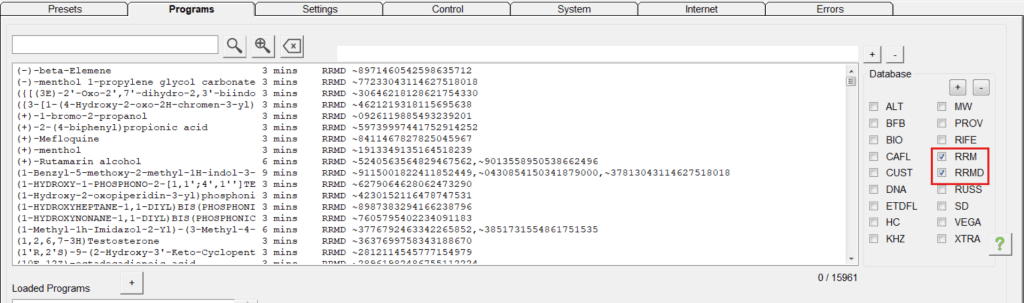
RRM and RRMD programs are already included in the Spooky2 main database. Downloads are available here. You can find these programs by ticking the RRM/RRMD boxes when searching for programs under Programs tab.
Will they affect the accuracy of BFB scans? Can we use Grade Scan/Refine Programs with the RRM/RRMD programs?
BFB scans are designed to detect and record reactions to given frequencies, whose range is decided by the settings of the selected BFB preset. The frequency programs we have in our database will not have an impact on the body’s natural reaction. There is no point to run Grade Scan/Refine Programs with the RRM/RRMD programs, as the frequencies are not estimates. Additionally, these programs are only meaningful with multiple frequencies, whereas the Grade Scan can only send one single frequency at a time.
Do I need to run the Terrain protocol before using these programs?
It is generally recommended to run Terrain first, especially if you have just started your rifing journey. The Terrain protocol is designed to make your body terrains more available or receptive to further treatments.
How long should I run RRM/RRMD frequencies for? Is there a minimum or maximum requirement?
There is no definite run time to prescribe for these programs. You can run them similar to other main database programs. For example, if you use Contact/Plasma mode, run them once or twice per day. For remote mode, you can run 24/7. It’s unlikely to “overdose” for running these frequencies too long.
RRMD programs act similarly to the actual physical substances. Therefore, please monitor your body’s reaction closely for any potential undesired effects. You can always choose to take breaks during your treatment, or modify your program portfolio according to your personal conditions to maximize your results.
What is the best way to find the right RRM/RRMD program to run?
We encourage our users to make use of the build-in encyclopedia function or do their own research online. To search with keywords in the Spooky2 encyclopedia, click on the magifier icon with a “+” under the Programs tab.

Can the XM Generator handle these high frequencies just as it does with the peptides? Why do I see a reduced frequency when I run the RRM programs?
Yes, you can use the XM Generator. Sub-harmonics are used by many programs in Spooky2. Spooky2 will always reduce these high frequencies internally. That’s why you don’t see the high frequency figures when you run these programs. Because the harmonic frequency is mathematically related, it will still be effective.
There are certain prescriptions that contain multiple components and have different active parts. Do you send each substance individually in different generators?
Yes, as some constituents depend on others to function.
When chaining these programs, is there a maximum limit on the total run time? Can we use RRM and RRMD programs together?
There’s no hard maximum limit. And you can use RRM and RRMD programs together.
For RRMD programs with only one frequency, are these programs compatible with most modes and shell presets? No specific limits?
Yes. Most non-peptide presets will work. Regard single-frequency programs as you would any other program in the main database.
For RRM/RRMD programs with multiple frequencies, how do I run them in different modes?
All frequencies need to be broadcast simultaneously. To use Contact/Coil/Remote, the current best approach is to use the JD MW Emulate shell, change the setting to “Out2 Runs Every Second Freq”, and set Out 2 harmonics to ODD when you load your preset. Make sure that Out 2 runs every second frequency in the program.


If we want to use Spooky2 Scalar to deliver RRM/RRMD frequencies, what settings are recommended?
For single-frequency programs, you can use the Scalar shell. For multiple frequencies, you will need to convert the program into audio and input using Scalar Harmony. For detailed conversion instructions (contributed by Bryan Yamamoto), please refer to this.
Can we imprint RRM/RRMD programs? Can we imprint multiple RRM/RRMD programs into one single sticker?
Yes. Imprinting allows all frequencies to be broadcast simultaneously. To imprint these programs, you can use the MW Emulate shell. And you can imprint multiple programs into one sticker.
Discover Our Live Session
John White, founder of Spooky2 and creator of the RRM/RRMD database, recently hosted a live SAMA session to share the science behind it and answer questions from our global community. Watch the video replay below.

When selecting remove duplicate frequencies, how does the program decide what to present since frequencies are shared by multiple conditions.
Hi Katrina. If there are duplicate frequencies under the same shell, the same frequency will act on all the applicable conditions. However, we recommend keeping the duplicate frequencies in general to achieve best consistency and effectiveness.
Hello,
I haven’t been able to find anywhere which preset to use to run the RRM and RRMD programs.
Thank you for your help.
Best regards
Hi Phil. You can use MW Emulate for imprinting. For contact and PEMF, the current best approach is to use the JD shell and change the setting to “Out2 Runs Every Second Freq” and set both output harmonics to be the same. For remote, you can use the Healing (Dual) preset.
where I set out2 harmonics to ODD ? Is this in the frequency limit area?
Hi! Yes it is. It’s located in the bottom-left corner of the Settings tab.
That area is labeled Frequency Limits (HZ). It says nothing about Harmonics. So if your update is correct about the bottom left you either need to update the software with the proper name or change this blog to reflect the correct software area name.
Hi Michael. In the Frequency Limits section, there are two dropdown boxes with harmonic options below the two rows marked “>” and “<”. by default, both dropdown boxes may show “octave.”
Hola. In the latest Spooky update (20260610) and its latest patch, the RRM database contains viruses, bacteria, etc., but I don’t see any substances listed. For example, if we take the first item on the list, Acanthamoeba, which is an amoeba, and I want to kill it with Plasma, I load the shell: Plasma, Killing, and then select “Acanthamoeba” in Programs. It takes 3 minutes. Do we do the same with any other shell?
RRMD is used for substances, but I see that it’s sometimes confused with RRM.
Thank you
Hi Gabriel. RRMs are pathogen-disabling programs whereas RRMDs are frequency programs for drugs and substances. Plasma mode is not John’s primary recommendation.
Still dont understand the RRM and RRMD at all…
Hi Hirad. We understand that RRM/RRMD is an advanced concept. The model provides another solution to pinpointing the key active frequency in pathogen-blocking. If you would like more personalized support, please contact our team at support@spooky2-mall.com
For example I find a substance in the RRMD Database with only one frequency I want to try with the remote modus does it matter then if use Healing or MW Emulate?
Hi Hermann. We have currently received positive feedback from those using MW Emulate. With that said, it is completely fine to experiement with both and see how your unique body reacts.
Hello, when mixing standard Hz Frequencies, say for Kidney support, or Skin Regeneration, AND RRMD and MW Vitamins in the SAME program, should we
use the Healing PRESET..? Not MW Emulate.. Thank you- I wanted to see if you agree with the below, as the Final Authority 🙂
[ AI Google, says, Yes.. ]
My Question: So, when running a program for kidney support, and adding mw & rrmd vitamins to it for support, which Preset should we choose:
Healing or MW Emulate?
Google AI ANSWER:
You should choose the Healing preset (specifically a standard healing shell preset like Healing (R) – JW
RUN HEALING JW PRESET- WHEN MIXING MW, RRMD, AND HEALING OR REGEN OF THE BODY.
Here is why this selection is critical for your setup:
1. The Preset Settings Must Match your Primary GoalYour main objective is kidney support and regeneration, which requires a Healing shell preset. Healing presets are configured with gentle, therapeutic waveforms (such as square waves with specific duty cycles or sine waves) that promote cellular recovery, minimize detox stress, and allow the body to absorb supportive frequencies safely.
2. MW Emulate Overrides Non-MW ProgramsThe Molecular Weight (MW) Emulate preset is a highly specialized shell preset. It is designed exclusively to convert mass values from the molecular weight database into raw radio frequencies, often using specific subharmonic settings. If you mix standard kidney support frequencies and RRMD frequencies into an MW Emulate preset, the software’s structural settings may distort or improperly play the non-MW frequencies.
3. Healing Shells Handle Mixed Databases PerfectlyThe standard Spooky2 Healing preset has no trouble processing mixed inputs. When you load a standard healing preset, you can freely search the database and stack:
1 Kidney support frequencies (standard Hz)
2 MW vitamin frequencies (converted properly by the software engine
3 RRMD vitamin frequencies (pre-calculated structural maps)
** It Also Stated- Run MW & RRMD Together: The Spooky2 team notes that these two calculation methods offer different layers of frequency insight.
Because they do not conflict, many users chain or loop the MW and RRMD programs together in a single custom playlist to ensure full coverage.
Hi! It is not recommended to mix RRMD programs, MW programs, and regular frequency programs in one shell preset as there are different requirements for each group.
You can put your regular frequency programs in one shell preset, say a Healing shell (if they’re all healing frequencies), and all MW programs in one MW Emulate shell.
RRMD programs require all frequencies to be broadcast simultaneously. The most convenient approach is to make imprinted stickers using the MW shell. Alternatively, you can refer to this post on the forum https://www.spooky2.com/forums/viewtopic.php?t=19283#p219136
Hello,
I have read in this blog and your replies to comments that you recommend using the ‘MW Emulate’ preset for RRM and RRMD frequencies.
But RRM frequencies are for pathogens (which should be removed from the body) and RRMD are for substances (which can be entrained in the body).
How then are you recommending to use MW Emulate for RRM (pathogens) frequencies ? Or the ‘healing (dual)’ preset ?
Shouldn’t they be used with ‘MW Remove’ or ‘Killing’ presets ?
I was not able to find this information anywhere on your blog or mall website since this frequency database got updated.
Thanks.
Hi Sean. RRM (for pathogens) are identified pathogen-disabling frequencies, rather than the pathogens themselves; RRMD (for drugs / substances) are identified active frequencies when certain substances take effect. Therefore, they’re meant to be “emulated.”
What if one wants to remove a substance can we use RRMD in a remove Shell?
Thank you
Hi Alessia. No, RRMD programs are not designed for “removing” or “blocking” specific substances. Instead, they are intended to represent the peak active frequencies associated with certain substances.
Looking to kill pathogens using RRM what preset do I need to use
Hi Jeff! For detailed usage guidance, please contact our support team at support@spooky2-mall.com. Our dedicated team will be happy to assist you.