For many women, pelvic floor issues are a quiet but deeply disruptive struggle that can impact everything from physical comfort to daily confidence. This article will walk you through Spooky2’s peptide approach. Spooky2’s peptide programs aim at addressing pelvic floor issues and related symptoms with carefully selected and engineered peptide frequencies, supporting your body’s natural ability to restore balance and regain vitality.
The Root of the Issue: Causes and Symptoms
Understanding the causes and symptoms of pelvic floor damage is the essential first step in choosing an effective recovery path. As a complex network of muscles and connective tissues, the pelvic floor is highly resilient—yet severe trauma or chronic strain can eventually lead to significant dysfunction.
Core Causes of Pelvic Floor Damage
Childbirth: Vaginal delivery can deeply stretch or tear delicate muscle fibers, fascia, and supportive nerves.
Aging: Natural hormonal shifts, particularly the drop in estrogen during menopause, lead to a loss of tissue elasticity and collagen.
Chronic Constipation: Continuous, repetitive straining can act as repeated mechanical trauma to the pelvic nerves and base.
Chronic Coughing: Heavy coughing caused by conditions like asthma or chronic bronchitis creates sudden, violent downward pressure spikes on the pelvic tissues.
Heavy Lifting: Improper techniques or weak core muscles during heavy lifting can force extreme intra-abdominal pressure downward.
Obesity: Excess weight places constant, daily structural stress on the pelvic tissues.
Surgery or Trauma: Pelvic procedures, such as hysterectomies, can disrupt and weaken supportive connective tissue networks or cause nerve damage.
Common Symptoms to Watch For
Abnormal Elimination: This includes stress urinary incontinence (leaking), fecal incontinence, chronic constipation, or urinary retention (difficulty fully emptying the bladder).
Hypertonia or Hypotonia: Hypotonia (weakness) leads to leaking and sagging organs, whereas hypertonia (muscles being too tight and cannot relax) causes chronic pain, spasms, and emptying difficulties.
Muscle Pain or Painful Intercourse: Often a direct result of hypertonic, overactive pelvic floor muscles that are unable to release tension.
Pelvic Organ Prolapse: A heavy, dragging feeling or foreign body sensation in the pelvis area caused by bulging organs (such as bladder, uterus, or bowel) and surrounding tissues.
Customize Your Healing Path
Spooky2 offers specialized peptide programs designed to address both pelvic floor tissue healing and its related symptoms. You can easily customize your recovery path by choosing the programs that best match your unique needs and selecting the most effective application method for your lifestyle.
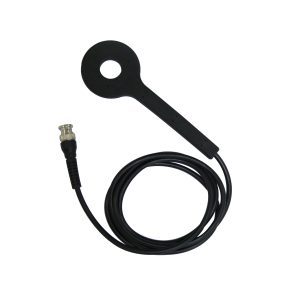
If you prefer a more direct, localized approach, you can also consider using the internal electrode in Contact mode for straightforward application. (Detailed instructions here) For those who prefer not to be tethered to a machine or want consistent, 24/7 support, Remote mode is an excellent option that can be used on its own or seamlessly combined with other application methods. For deep tissue penetration, the PEMF coil is exceptional at accelerating healing and promoting cellular repair and regeneration, which is a great add-on to your personal wellness portfolio. (Read more here) Make sure you use the presets or shell presets that correspond with your selected modes.
| Symptoms | Pelvic Floor Dysfunction | Pelvic Organ Prolapse |
| Program Suggestion | Pelvic Floor Dysfunction Hypotonic Pelvic Floor Hypertonic Pelvic Floor | Uterine Prolapse Rectal Prolapse Organ Prolapse (Post-hysterectomy Recurrent) Perineal Descent Cystocele Rectocele Urethrocele |
| Symptoms | Abnormal Elimination | Muscle Pain |
| Program Suggestion | Bowel Incontinence Urinary Incontinence Dyssynergic Defecation Urinary Retention Hypermobile Urethra Nerve Injury Bladder Areflexia | Dyspareunia Levator Ani Syndrome Vaginismus Vestibulodynia |
Daily Care Tips
Pelvic floor healing takes time. And confidence can be gained along the path. Incorporating these daily habits can help maximize your results with Spooky2 and protect your pelvic floor from further daily strain:
Adopt the ‘Blow as You Go’ Breathing Rule: Never hold your breath when lifting heavy bags, standing up, or exercising. Holding your breath locks pressure into your abdomen, forcing it straight down onto your pelvic floor. Instead, exhale during the hardest part of any movement to naturally lift and protect your deep core. Incorporating gentle core stability training can further build abdominal strength and provide long-term support for the pelvic base.
Use a Toilet Footstool: When passing a bowel movement, use a stool to elevate your knees above your hips. This simple position change helps relax the puborectalis muscle and straighten the rectal path, so that you can eliminate easily without straining the pelvic wall.
Differentiate Between Relaxing and Strengthening: If your primary symptom is pelvic pain or tightness (hypertonia), stop doing Kegels. Clenching an already overworked, tight muscle will only worsen your symptoms. Focus on deep diaphragmatic breathing and gentle yoga stretches (like child’s pose) to relax the tissue first.
Hydrate to Protect Connective Tissue: Peptides rely on adequate hydration and cellular health to promote healing. Drinking plenty of water can help keep both your stool soft (preventing constipation), and the extracellular matrix of your pelvic ligaments plump, elastic, and resilient.
Real Results from Real Users
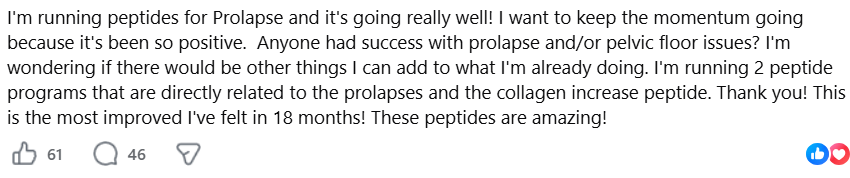
A user from the Spooky2 Rife for Life group recently shared her success with the Prolapse peptide program. She described it as “the most improved I’ve felt in 18 months.”
(Source: https://www.facebook.com/groups/spooky2/permalink/3399163353578877/)
Recommended Accessories
-
Contact Accessories for Rife Machines, Rife Machine Accessories
Spooky2 Tens Internal Electrode
Spooky2 Internal Electrodes can be inserted to provide targeted, localized support. The softly curved shape and narrow neck assist with easy insertion and comfortable use, while the external flange ensures precise retention and placement.
Connect it to the Colloidal Silver port of the Spooky2 Boost for gentle support.
Spooky2 Tens Cable needed to connect internal electrode to generator can be ordered here.
SKU: SP-3G220-04 -
-
Rife Machine Accessories, Rife Machine Remote Healing Accessories
Spooky2 Remote v2.0
Spooky2 Remote v2.0 can deliver frequencies to you at any distance, which was referred to as the “spooky action at a distance” by Albert Einstein.
This improved version provides more consistent results, better frequency response, and quieter operation. The streamlined design features protection against sharp edges, improved indication lights, and simplified sample placement.
Spooky2 Boost needed to connect Spooky2 Remote v2.0 to generator can be ordered here: https://www.spooky2-mall.com/product/spooky2-boost-v3-1/
Note:
- We recommend connecting one Spooky2 Remote v2.0 to one Spooky2 Boost.
- The Spooky2 software requires Windows.
Gentle yet Effective Energy Support
Begin your body energy balancing journey with Spooky2 today. Experience a holistic approach designed to support your body’s natural alignment. With our 30-day satisfaction guarantee, you can get started with total confidence. SKU: SP-2G210-04
 -
Power & Connection Accessories, Rife Machine Accessories
Spooky2 Boost v3.1
The new and improved Spooky2 Boost v3.1
- Boosted power for either Spooky2 Remotes, contact mode, or PEMF coil operation
- Regular sockets for lower power use.
- Colloidal Silver socket for making top-grade Colloidal Silver.
- Safely make true Colloidal Silver that is fresher and better than most commercially available products, at a fraction of the cost.
- Safe extended-period Contact Mode energy balancings.
Advantages of the new Spooky2 Boost include:
- Stylish design
- More compact
- Indication lights
Spooky2 Summer Healing Month Sale!
7% OFF Sitewide – Use Code: Healing2026
SKU: SP-3G500-03